Showing posts with label Olympian Fig. Show all posts

August 15, 2026

How to Grow and Harvest Ripe Olympian Figs

Yes, Olympian Fig trees can be container-grown. Started from a cutting in the summer of 2023, my 3-year old tree is in a 17-inch pot. I bottom dressed it this Spring, as it had settled down about an inch since it was potted in April 2025. It was a good opportunity to inspect the roots. Thankfully, there were no signs of root knot nematodes.

What's this got to do with bees? As bee survival rates decline, it's important to know what your #GrowItEatIt options are. Figs are a food crop you can reliably produce without bees.
It's a "self-watering" pot, which means it has a reservoir. Figs are thirsty trees, and it turns out that 12 inches of rain in the month of July is just the right amount. That is record rain, but generally speaking Coastal Virginia is a very wet place, so I lined the sides of the pot with Better Than Rocks, to discourage root rot and encourage air pruning of the root ball. The latter 🤞 should help keep the size of the tree in check. The red mesh on top of the soil is repurposed onion bags, to stop squirrels from planting acorns, another item of abundance here.
 
Especially when it rains that much and strips the soil of nutrients, regular fertilization is important for potted trees. Just don't feed when it's really hot and plants are stressed. 
Olympian can produce a breba crop, and this Spring we had 12 figlets—that fell off when the tree went into leaf-growing mode. 
 

This is our very first fig harvest. The Summer crop began to develop in early June. The ribbed figlets were steadfastly green for more than 2 months. Once they go a little jaundiced, ripening happens quickly: 3-4 days and they're ripe. They're ready to harvest when they slip off the tree, like a ripe melon slips off its vine. 


After a very wet (and hot) July, we had a very hot dry spell, followed by a couple of severe thunderstorm just as the figs were ripening. With the irregular watering, one started to crack. An organza bag worked to protect the fruit from sugar ants while it ripened. 

Four figs. That was our entire crop. A nice sized fig (paring knife in photo for scale), they weighed between 1.25 and 1.75 ounces each. Thin skinned, creamy smooth, and delicately sweet… we couldn't be happier with our homegrown figs!

My Prune & Propagate Plan

I plan on pruning this tree for maximum fruit production next year, and to have cuttings! For both to happen, I must wait until the tree is fully dormant (February to early March).  

What about you? Have you grown figs? Are you interested in a cutting? 

October 29, 2023

Olympian Fig Tree, Air Layer vs. Cutting Prop

ON THE TOPIC of bees, figs can't be bee-pollinated! Their flowers are inverted and require a specialized pollinator. They're pollinated by wasps, aptly called fig wasps.

OFF-TOPIC: Here's an update on my fig tree propagations. As a reminder, in July 2023 I took one stem cutting and did an air-layer. The donor tree was dying from root knot nematodes (RKN), and the timing was ideal. But I didn't know if one method was better than the other. Have a look at how they compare —with updates into 2025.

Cut-branch propagation, 6-weeks from being taken off the donor plant (R) and being rooted in soil. Here it's getting its third pot-up. The donor plant is no worse for the wear of taking props.

Air-layered propagation: despite my negligence and letting the sphagnum dry out, look at that root formation! Click on the picture for a zoomable view.

Late-August 2023 (6 weeks after taking the cuttings): The cutting prop lost all but one leaf but then grew so fast it had to be potted up three times. It put all its energy into a single trunk. The well-rooted air-layer prop's first potting was into a 1-gallon nursery pot, where it sent up a whole new branch. The difference in leaf size is remarkable. The cutting (in the grow bag in the photo below) is pushing out huge leaves. I can only guess that the single trunk, which is thickening up nicely, is funneling lots of energy into leaf production. 

Another 6 weeks: The air-layer prop doubled its number of leaves and is working to push out a third branch. I wasn't planning on potting up again but the squirrels dumped it over, looking for a place to plant acorns.

It rains so much here in Virginia, 20 inches in a 3-month period this summer, there's no such thing as a pot with too much drainage. Fabric grow bags work pretty well but you do have to watch out for mold and mushrooms growing on the bags. I haven't had ants move into my grow bags like they do my plastic pots. Every pot with a drainage hole has an ant problem, that is, until I scratch neem seed meal into the soil. It takes care of them like magic! Even though I have a solution, I'd rather not have the problem in the first place, so I'm switching to grow bags whenever possible.

The green fibrous stuff is Better Than Rocks, which I use in my outdoor pots with drainage holes. It is the only physical barrier I've found that keeps the ants from using the holes as doorways to their new favorite home.

I repotted the dumped over fig into a grow bag like its sibling. It's not quite apples-to-apples, though, because it has superior drainage with a bottom layer of Better Than Rocks. Container-grown figs will let you know if they aren't getting enough drainage, through brown spots on the leaves.

The Three Little Figs

October 2023: I finally found a use for nonrecyclable plastic onion bags! They're pretty effective at keeping the squirrels from planting acorns (until they break apart from exposure to the elements). The purple one is the cutting prop, red is the air-layered prop. See the difference in leaf size? The comparison is somewhat unfair, though. The air-layer was attached to a stressed donor plant (on the right). The donor has lots of fresh RKN galls so the neem seed meal and straight vermicompost did not remedy that problem. I'm having a hard time with the thought of throwing it away but it's too late in the year to take more propagations. What would you do?

April 2024 Update

Winter's are pretty mild in coastal VA. The trees stayed outside all winter, their pots simply snugged up against the brick wall of our condo. They even held their leaves throughout the dormancy period, Nov-March.

The cutting prop is single-stemmed and about 2-feet tall. The air-layer tree split into two branches so is half the height.

tree-form from cutting prop (L), multi-stem from air-layer prop (R)

June 2024 Update

Double bumps! They're a fig tree thing. One bud is a lateral (branch) bud; the other is a figlet or fig "embryo." Fig trees generally bear fruit on new, growing shoots (green wood) but may also fruit on one-year-old stems.

Double Bump: which is a branch bud and which is a figlet is TBD. Gotta guess?

July 2024

One year since taking the cuttings: nothing to report so here's a recipe! Roasted Figs with Mascarpone, from Mark Bittman's How to Bake Everything (highly recommend!)
July: the cutting-prop tree, right outside the kitchen door, is now 3-feet tall.

Late-August 2024 update

I'm seeing figs at the farmers markets, so I guess all my trees are giving me in 2024 is vegetative growth.
purple = cutting propagated, single-stemmed fig tree; red = air-layer propagated, multi-branched fig tree
One-year old trees are capable of fruiting but mine are waiting for year 2. As a matter of fact, I can see the formation of a breba! Brebas are a small Spring crop produced on last year's new growth. According to the Fig Boss, it comes 4-6 weeks ahead of the main Summer crop. 
Double bumps on the vertical tree form (cutting prop). Pointy buds are branch buds.

The rounded bump is the breba. This one's on the multi-branched shrub form.

April 2025 

Both trees overwintered 2024/25 in 3-gallon plastic pots. I re-homed the air-layered prop in a 17" rolling planter as its permanent home. That's as big as I can go with my tiny patio garden. 
Unfortunately, despite taking precautions the cutting-propagated tree developed RKN so it went into the trash.
In nursery terms, I think this planter would be equivalent to a 10-gallon container.
So this is where my almost 2-year old—started from an air-layer—fig tree is at. Now we wait for fruit.

More reading on fig pollination: Everything You Never Wanted To Know About Figs

July 13, 2023

Olympian Fig Propagation & RKN Part 2

My Olympian fig has been looking pretty good in spite of the RKN infestation. Here is how it looks in direct comparison to two months ago when I repotted it in vermicompost. Same shape but a little bigger and more leafy. There's a nice new branch coming straight up the middle that you can't see.

To my dismay, upon entering the hot and humid, plant stressors time of year, black spots are developing on the leaves. Maybe the RKN is not being controlled by the vermicompost as I'd hoped. It's too early to disrupt the soil to check the roots, so I'm hedging my bets with stem propagation. I chose one stem for air layering and one as a cutting.

The air-layered branch is foil-wrapped. The cutting is in a "deep" pot made from stacked bottomless seed-starting pots.
I bought a canister of rooting hormone, and my natural desire to propagate plants has now surged. I've got some cute Night Blooming Cereus cuttings, already rooted and with new growth, if you're interested.  
Excess leaves trimmed, stem girdled and dipped in rooting hormone.
Figs are supposedly crazy easy to root, but I'm helping my cutting root faster by girdling the stem where it's a bit green (young wood is this year's growth) and using rooting hormone. Girdling disrupts the flow of water and nutrients, which somehow encourages root growth.
I believe that each nodule is capable of becoming a root but they're clustered on old wood. I girdled the stem where the wood isn't hardened yet.
The nematodes are soil-bound so rooting stems is the only way to have RKN-free roots. A well-rooted cutting, if large enough, is capable of producing fruit as a 1-year old plant. For me, 2-3 years is likely with these small pieces.
Envisioning the shape of the fig tree after taking the cutting and air-layered branch off, I think it'll look good, assuming the tee survives, that is.
If the original plant growing in vermicompost beats the RKN, the cutting roots, and the air-layered branch roots, I'll have three Olympian fig trees. I'll be happy with just one so maybe a couple of my friends will get lucky.
If you click on the photo for the enlarged view, you can see that black spots are developing. Luckily, they're on just the leaves considered "excess," which were getting trimmed off anyway.

I do not know what the black spots are. I'm assuming "not good." I suspect the 7.5+ inches of rain we had in June had something to do with it. Even with a healthy root system, that's a lot of water for a young tree to manage.

This is the branch I chose for air-layering. Instead of girdling the branch, which remains attached to the plant, I only scratched away bark on three sides. I wrapped the branch with a small plastic water bottle stuffed with moist sphagnum moss. It's covered in foil to create a dark environment. All this encourages root development, and if it goes well the plastic bottle will be full of roots in a month or two.

Here is a reference on fig propagation:  Getting figgy with it

What's growing on in your garden? Are you growing figs?

P.S.: The beekeeper's guild is turning out to be a bust. I'm assuming the top-bar aspect of our beekeeping style is the problem. They've already done their honey harvest here so the 2023 season's over. But we chatted with some Master Gardeners at the Virginia Beach Honey Festival and have some ideas for next year. Stay tuned!


May 03, 2023

2 posts in 1: Beekeeping Mentorship & Figgy Problems

News on the beekeeping front: I'm waiting for the Southeast Virginia Beekeepers Guild to set us up with a a beekeeping mentor! Being matched with one with topbar or Warré hive experience is, not surprisingly, the challenge. And on top, we've asked for a place to put our hive/s since our condo doesn't allow hives on our patio. While waiting patiently as swarm season passes us by, I'm dealing with a little figgy problem.

Last spring, I was gifted a small Olympian fig tree. Now I've got problems. Thousands of them.

It appeared as if it had been recently dug up and potted to be given away, i.e., it didn't have a great root system and was loose in its pot. Spring turned into summer, summer into fall. Lil Figgy pushed out some small leaves but never grew bigger. It just sort of was. I worried it wasn't strong enough to make it through winter, and breathed a sign of relief when it broke dormancy. I actually was just thinking 2023 might be the creep year (out of sleep, creep, leap) but then I saw a knobby root sticking out of the soil. Digging a bit down, I saw another, and another, and then strings of them. I googled "root knots on fig" and, unlike those on legumes, these are bad.
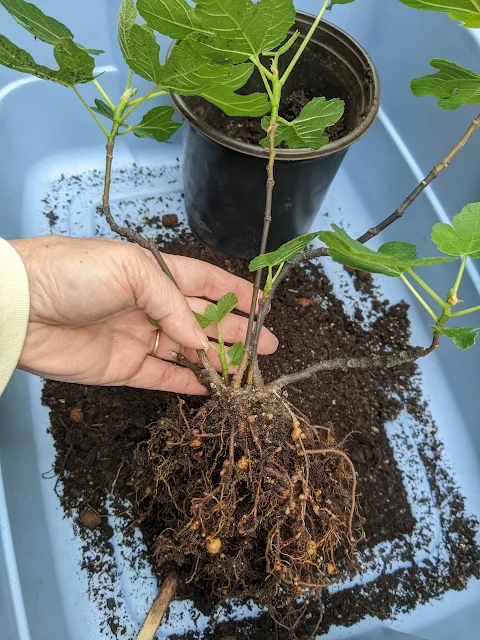
Root-knot galls on fig tree roots.

Root-knot galls are caused by harmful nematodes. Root Knot Nematodes (RKN) are microscopic worms that are common in sandy soils. RKN feed on roots with needle-like mouthparts, and parasitizing fig trees is a known problem. Particularly when container-grown, the root system can become damaged to the point where the plant cannot properly absorb water and nutrients. 

Even though the galls harbor egg-laying adults, Lil Figgy has too many affected roots to just cut off the galls. Instead, I think the best I can do is give it clean potting mix and some nutrient-rich organic matter, something RKN do not like. Thousands of root-knot juveniles can be present in just a tablespoon of soil, so I removed as much soil as possible before repotting it. I watched a video on YouTube that gives me hope that my treatment plan will eliminate the galls.

Earthworm Castings and Neem Seed Meal

The video says worm castings are "The Cure for Nematodes" but, honestly, I have no idea how to get castings out of my Wow Worm Farm. Since I needed castings and rich organic matter, the easiest thing to do was just use finished vermicompost as is. I opened the worm bin, and as usual worms immediately retreated from the light. I fluffed up the top two inches and went to the grocery store. By the time I got back, most of the worms had burrowed down, allowing me to scoop up mostly worm-free vermicompost. I turned in some neem seed meal, another natural nematicide, and repotted the fig into a smaller pot. Now if it grows well, I'll know quickly. And when roots come out the bottom and it's ready to pot up, I'll find out if the treatment worked. My hope is to see the galls gone, and you can be sure I'll share if it does!

Olympian fig tree, freshly repotted in finished vermicompost and looking pretty good.

The PittMoss as worm bin bedding is working really nicely. The worms process it in to a fine dark compost. Contrary to other bloggers' experience, I find torn cardboard takes a long time for the worms to break down and it constantly molds.

Fresh PittMoss bedding vs Finished compost

My one issue with PittMoss is that it is sold in nonrecyclable plastic bags. I'm doing my best to go plastic-free so have started to collect egg cartons. If you've got a heavy-duty confetti shredder, the paper pulp bits make a great worm bedding that breaks down faster than shredded newspaper.